




Important Notice: Amprod Acquires Simmtech

Industry InSights

How to Choose the Right Alloy Wheel Curing Oven?

Choosing an Alloy Wheel Curing Oven is a process decision, not simply a choice between gas and electric heat. Wheel size, coating chemistry, production rate, and available floor space all shape the right specification. A glossy finish can hide uneven curing, so oven-air temperature alone is not enough. Small details matter.

The U.S. Department of Energy’s 2015 Quadrennial Technology Review reports that process heating accounts for about 36% of energy use in U.S. manufacturing. That figure is not wheel-specific, but it shows why heat efficiency deserves attention. For wheel production, compare usable chamber dimensions, loading method, airflow pattern, temperature controls, and recovery time after loading. Ask suppliers to explain how they verify temperature uniformity under real operating conditions, with wheels in place—not only in an empty chamber.

Curing schedules must also match the coating maker’s stated time and part-temperature requirements. Powder Coating Institute technical guidance highlights the importance of reaching the correct part temperature for the required duration. Request a documented temperature profile, realistic capacity figures, and details on maintenance access before comparing quotations. Consider future wheel sizes and shifts, too. A compact oven may suit today’s line but constrain tomorrow’s output. There is no perfect specification; careful testing and clear operating records help reveal trade-offs before they become costly.
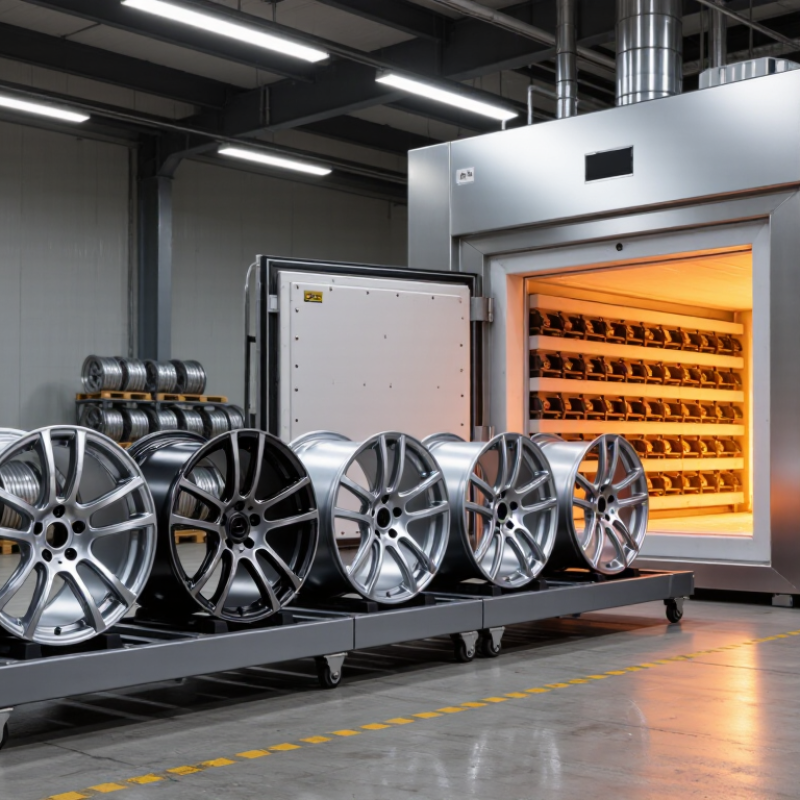
How to Choose the Right Alloy Wheel Curing Oven?

Define the Curing Requirements for Alloy Wheel Coatings

How to Choose the Right Alloy Wheel Curing Oven?

Define the Curing Requirements for Alloy Wheel Coatings

Start with the coating manufacturer’s technical data sheet. Record its specified metal temperature and required holding time. The oven’s air temperature is not the same as the wheel’s temperature. A display reading of 180°C does not prove the wheel reached 180°C. Define acceptable heating and cooling rates too, especially if the coating or wheel design is sensitive to thermal stress.

Wheel size, mass, and loading affect the cure profile. A heavy wheel may heat more slowly than a small one. Small wheels heat faster. That matters. Test representative wheels with attached temperature probes, placing them on both inner and outer surfaces. Check several positions in a loaded oven, since airflow and spacing can create hot or cool zones. Keep records of the profiles and compare them with the coating’s stated requirements. One test is rarely enough; production loading may behave differently.

Tips: Ask the coating supplier to confirm the cure window. Validate the oven with a fully loaded rack, not an empty chamber. If results vary, review probe placement and airflow before changing the setpoint.

Compare Oven Types, Heating Methods, and Temperature Ranges

Batch ovens suit varied wheel sizes and short production runs; conveyor ovens maintain steadier throughput for repeat jobs. Forced-air convection distributes heat around complex spoke shapes. Infrared heating responds quickly, but recessed areas can receive less energy. A hybrid system may help, though it adds control complexity.

Temperature means the wheel’s metal temperature, not merely the oven’s display. The Powder Coating Institute reports common powder-coating cure schedules around 177–204°C, while stressing that the coating’s specified schedule governs. A heavy wheel may take longer to reach that range than the chamber air. DOE’s process-heating guidance also emphasizes matching heat delivery and controls to the load. Small details matter.

Tips: Attach thermocouples to the barrel and a thick spoke, then record actual part temperature and dwell time. Check several wheel positions; one hot reading can hide a cold corner. Don’t size an oven by advertised capacity alone. I would verify airflow with loaded wheels, not an empty chamber.

How to Choose an Alloy Wheel Curing Oven

Typical powder-coating cure windows by formulation (part metal temperature, °C)

Batch ovens suit smaller runs and frequent product changes; conveyor ovens suit continuous, higher-volume production. Electric and gas-fired systems can both support powder-coating cure temperatures, so compare utilities, energy costs, airflow, temperature uniformity, and throughput. These are indicative part-metal temperature ranges—not oven-air setpoints. Always follow the coating supplier’s technical data sheet and verify the wheel’s metal temperature.

Match Oven Capacity and Airflow to Wheel Size and Workload

How to Choose the Right Alloy Wheel Curing Oven?

Match Oven Capacity and Airflow to Wheel Size and Workload

Choose an oven around the wheels you actually process, not an idealized average. Measure the largest wheel’s diameter and width, then allow room for racks, loading tools, and airflow around each part. A tightly packed chamber may fit more wheels, but blocked air can create uneven heating. That matters when coatings need a consistent cure.

Estimate workload by shift: how many wheels must be ready, and how often will batches enter the oven? A larger chamber can help with high-volume production, yet it may waste energy when routinely run half empty. Small batches need room to circulate. They also need a sensible heating cycle. Check the coating supplier’s specified part temperature and cure time; oven air temperature alone does not confirm the wheel has reached the target.

Airflow should move evenly across the load, without leaving sheltered corners behind racks or near the door. Ask how circulation performs with your wheel sizes and rack layout, not just with an empty chamber. Temperature profiling on a representative load can reveal cold spots. It takes effort. Still, guessing from the display is a weak substitute. One detail is easy to miss: changing wheel spacing can alter airflow, so validate the setup you will use day to day.

Evaluate Controls, Safety Features, and Energy Efficiency

An alloy wheel curing oven should hold temperature evenly across the load, not merely display a convincing setpoint. Ask for calibrated sensors, multi-zone control, and recorded temperature profiles using a loaded rack.

The U.S. Department of Energy’s process-heating guidance estimates that process heating accounts for roughly 36% of energy used in manufacturing. That makes control quality an operating-cost issue, not just a dashboard feature. Still, dashboards can mislead. Verify each wheel.

For safety, check for independent over-temperature protection, airflow monitoring, door interlocks, and alarms visible to operators wearing gloves. Ask how the oven responds if a fan fails or a thermocouple drifts; a safe shutdown matters more than a warning light. Request test records showing temperature uniformity under representative loading, plus a clear calibration schedule.

Scrutinize energy claims by comparing measured fuel or electricity per batch, warm-up time, insulation condition, and exhaust losses under similar production conditions. Responsive controls and sound insulation may reduce idle heating, but frequent door openings can erase those gains. That detail is easy to overlook.

Check Installation Needs, Maintenance, and Supplier Support

An alloy wheel curing oven must fit your production space, not just the floor plan. Measure the full unit, loading doors, and the space needed to move racks safely. Check floor capacity, electrical supply, exhaust requirements, and clearance around hot surfaces with qualified site staff. A drawing can look generous, yet a tightly placed oven may leave no room to service a fan or open a panel. Allow more space than seems necessary.

Tips: Before ordering, photograph the installation area and record door widths, ceiling height, and utility locations. Ask the supplier to review these details.

Maintenance access matters during everyday production. Ask how to inspect heating elements, fans, temperature sensors, and door seals. Find out whether routine checks require special tools, and whether spare parts are readily available. Confirm that the oven can maintain an even temperature across the wheel load; request commissioning support to verify the actual curing profile. A display reading alone may not reveal uneven heating.

Supplier support should cover installation, operator training, troubleshooting, and parts availability. Request clear service response times and written maintenance guidance. If support depends on remote diagnosis, check what information technicians need, such as alarm codes or temperature logs. Small details are easy to overlook, and a missed detail can delay production.