


Important Notice: Amprod Acquires Simmtech

Industry InSights

How to Choose the Right Industrial Equipment Solutions

Choosing industrial equipment is not a catalog exercise. A pump that looks efficient on paper may struggle with your actual fluid, shift pattern, or maintenance capacity. The right industrial equipment solutions should fit the process, workforce, site conditions, and long-term operating budget—not just the purchase price.

Energy use deserves careful attention. The International Energy Agency’s Energy Efficiency 2023 report estimates that industry accounts for about 37% of global energy consumption. That figure makes efficiency a practical selection criterion, especially for equipment that runs continuously. Compare expected energy use at realistic loads, not only the best-case rating. A compressor operating through a dusty night shift tells a different story than one tested under ideal conditions.

Check reliability, too. Ask suppliers for service intervals, spare-parts lead times, warranty limits, and references from facilities with similar workloads. For a production line, even a short stoppage can disrupt labor schedules and delivery commitments. Yet a longer warranty does not guarantee quick repairs. That detail is easy to overlook.

A site assessment helps expose constraints such as floor space, access for lifting, noise, heat, and existing power connections. Request clear documentation on installation, operator training, and performance testing. Then compare options using measurable criteria: capacity, energy demand, expected maintenance, and compatibility with current systems. No spreadsheet captures every operating surprise. Leave room for uncertainty, and verify supplier claims against your own production conditions before committing.
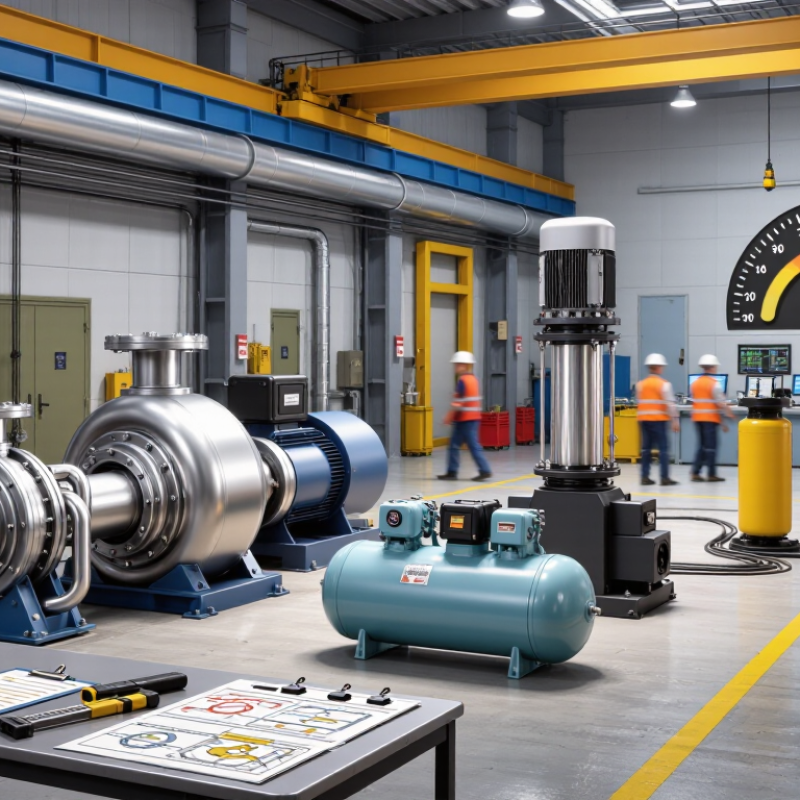
How to Choose the Right Industrial Equipment Solutions

Define Operational Requirements and Performance Goals

Before comparing industrial equipment solutions, define the work the equipment must perform. Record the material type, expected throughput, operating hours, and available floor space. Include real measurements, such as the height of a loading dock or the width of an aisle. “High capacity” is not a useful target by itself. Specify a rate, like 40 units per hour, and note whether demand changes by season. Consider operating conditions too. Dust, vibration, moisture, and temperature can affect reliability and maintenance needs.

Tips: Ask operators to describe daily tasks and recurring delays. Check utility limits, service access, and training needs. Keep assumptions visible.

Set performance goals that can be checked after installation. Useful measures include output per shift, acceptable downtime, energy use, and changeover time. Choose targets that reflect actual production, not just an ideal day. A short trial or a review of operating records can help. Still, records may be incomplete, and estimates can be wrong. That is worth admitting early. Leave room to revise targets as you learn more. Document who will measure each result, how often, and what baseline will be used. Clear requirements make equipment comparisons more practical and help teams spot trade-offs before purchase.

Identify Suitable Industrial Equipment Types and Configurations

Choosing suitable industrial equipment starts with the task, not the catalog. Define the material, required throughput, operating hours, and acceptable variation in output. A pump handling clean water has different needs from one moving abrasive slurry. Likewise, a conveyor for warm, dusty parts may need different belts, guards, and drive arrangements than one serving a packaging line.

Match the equipment type to the process step. Pumps move fluids; compressors supply air; mixers blend ingredients; conveyors transfer goods; and filtration units remove unwanted particles. Then compare configurations: capacity, motor size, mounting position, control options, and materials that contact the product. Check available floor space and utilities too. A machine may fit its duty but still exceed the site’s electrical supply or leave too little room for maintenance access.

Small details matter. Ask operators where jams, leaks, or changeovers occur, and review actual production records rather than relying only on peak estimates. Consider cleaning frequency, spare-part access, noise, and the skill level available for routine servicing. A neat spreadsheet can still miss a blocked access panel or a floor drain in the wrong place. There is no perfect configuration for every shift; document assumptions, test critical requirements, and revise the selection when site conditions prove different.

Compare Technical Specifications, Compatibility, and Safety Standards

Choosing industrial equipment starts with the work it must perform, not the brochure headline. Compare capacity, operating speed, duty cycle, power requirements, and environmental limits side by side. A pump handling warm, abrasive liquid, for example, needs different materials and seals from one moving clean water. Check dimensions and connection types against the existing line, too. A small mismatch can mean new fittings, extra downtime, or an installation that simply will not fit.

Compatibility goes beyond physical connections. Confirm that controls communicate with existing systems and that the equipment can handle normal load changes without frequent resets. Ask suppliers for test data, maintenance intervals, and clear operating limits. Then review safety standards relevant to the equipment, site, and location. Verify guarding, emergency stops, electrical protection, and documented risk assessments with a qualified safety professional. Requirements can vary, so do not assume a certificate alone settles the question. Small details matter.

A comparison spreadsheet helps, but it can also make uncertain figures look precise. Mark assumptions, such as expected hours of use or peak temperature, and check them against actual site conditions. I would revisit those assumptions before purchase; they are easy to underestimate when a line is under pressure to keep running.

Evaluate Suppliers, Total Costs, and Lifecycle Support

How to Choose the Right Industrial Equipment Solutions

Evaluate suppliers beyond the quoted price. Ask for documented service response times, technician availability, spare-parts lead times, and training details. Request references from facilities with similar operating hours and conditions. A polished proposal may still leave gaps. Check what happens when a critical component fails on a weekend, not just during a scheduled visit.

Compare total costs across the equipment’s expected life. NIST’s Life-Cycle Costing Manual outlines a method that considers purchase, operating, maintenance, and replacement costs. Include energy use, consumables, installation, and likely downtime in your estimate. The U.S. Department of Energy’s Operations & Maintenance Best Practices guide estimates predictive maintenance can reduce maintenance costs by 8–12% compared with preventive maintenance, and 30–40% compared with reactive maintenance. Treat these as estimates, not guaranteed savings. Actual results depend on the equipment and site.

Tips: Ask suppliers to show assumptions behind energy and maintenance estimates. Get service commitments in writing, and price essential spares before signing. A spreadsheet can still miss awkward realities, like limited floor space or a long wait for a trained technician. Check those details on site.

How to Choose the Right Industrial Equipment Solutions - Evaluate Suppliers, Total Costs, and Lifecycle Support

Illustrative comparison of three anonymous equipment proposals. Cost figures are planning estimates in USD for a five-year evaluation period; actual costs depend on equipment type, operating hours, location, and contract terms.

Evaluation area Measure Proposal A Proposal B Proposal C What to verify
Supplier and solution fit
Application fit Capacity and operating range Meets stated duty; limited capacity margin Meets stated duty; moderate capacity margin Meets stated duty; highest capacity margin Confirm peak load, operating environment, product specifications, and future demand.
Technical compliance Required specifications addressed All listed requirements addressed All listed requirements addressed One optional feature requires clarification Review the compliance matrix, exclusions, drawings, and acceptance criteria.
Supplier experience Relevant project references 2 references offered 4 references offered 3 references offered Contact references with similar equipment, process conditions, and service needs.
Delivery and commissioning Estimated time from order 14–18 weeks 16–20 weeks 20–24 weeks Confirm lead time, site-readiness requirements, commissioning scope, and delay remedies.
Total cost of ownership (USD)
Equipment purchase One-time quoted price $48,000 $58,000 $72,000 Check included accessories, controls, taxes, freight, and quote validity.
Installation and commissioning One-time planning estimate $4,000 $5,000 $6,000 Confirm electrical, foundations, integration, testing, and operator-training costs.
Energy Estimated annual operating cost $12,000 $9,000 $7,500 Compare measured or guaranteed consumption under the same duty cycle and energy rates.
Planned maintenance Estimated annual cost $3,500 $2,500 $2,000 Include labor, consumables, service visits, and recommended maintenance intervals.
Unplanned downtime Illustrative annual cost allowance $2,000 $1,000 $500 Estimate using site-specific lost production, recovery time, and likely failure scenarios.
Estimated five-year total Purchase + installation + five years of energy, maintenance, and downtime allowances $139,500 $125,500 $128,000 Recalculate with local energy prices, actual operating hours, financing, and disposal costs.
Lifecycle support and risk
Warranty Illustrative proposed coverage 12 months 24 months 24 months Check start date, covered parts and labor, exclusions, travel charges, and claim process.
Service response Illustrative target for critical issues Within 2 business days Within 1 business day Within 4 hours Make response times contractual and distinguish response from on-site repair time.
Spare-parts support Illustrative availability commitment Common parts stocked; availability to be confirmed Critical parts listed with estimated lead times Critical parts stocked locally; inventory to be confirmed Request a critical-spares list, pricing, obsolescence policy, and replenishment lead times.
Training and documentation Included handover materials Operating manual and basic training Manuals, maintenance schedule, and operator training Manuals, maintenance schedule, and operator training Confirm language, training duration, digital documentation, and future refresher options.
End-of-life planning Upgrade and decommissioning support Not specified in proposal Upgrade options available on request Decommissioning scope available on request Clarify software support period, upgrade path, data access, and removal or recycling costs.

The proposal labels and service terms are illustrative, not claims about actual suppliers. Obtain written quotations and validate all assumptions before making a purchasing decision.

Validate the Selection Through Testing and Implementation

Industrial equipment should be validated under real operating conditions, not just during a polished demonstration. The U.S. Department of Energy’s 2022 Industrial Decarbonization Roadmap reports that industry uses about 30% of U.S. primary energy and generates roughly 30% of energy-related carbon emissions. Small efficiency errors matter. Before a pilot, record a baseline for throughput per shift, energy use per unit, scrap, changeover time, and maintenance hours. Keep product mix and operator settings in the test log.

Run the equipment through representative shifts, including startup, changeovers, and brief stoppages. The International Energy Agency’s Energy Efficiency 2023 report estimates that industry accounts for about 37% of global final energy consumption, making measured performance more useful than brochure claims. Compare pilot results with the baseline, and check safety interlocks, vibration, heat, and access for routine servicing. A test can still be too tidy. Include operators and maintenance staff; their observations may reveal awkward controls or cleaning delays that short trials miss. During implementation, set acceptance thresholds, train each shift, and review performance after several weeks. If results drift, investigate settings, materials, and work practices before assuming the equipment is at fault.