




A cleanroom panel can look simple in a catalog, yet small details affect installation and daily maintenance. This guide to Top Hand Made Cleanroom Panel Manufacturers in China focuses on practical evidence, not polished claims alone. Buyers can compare panel construction, available core materials, surface finishes, dimensions, and customization options. Details matter.
A reliable supplier should explain how panels are made and how joints, corners, and edges are finished. Ask for product drawings, relevant test documentation, and clear descriptions of inspection procedures. Where possible, review a physical sample. A smooth painted surface may look convincing, but edge sealing and dimensional consistency deserve equal attention. Requirements also vary by project, so a product that suits one facility may not suit another.
The manufacturers featured in this overview can be assessed by production experience, technical communication, quality controls, delivery planning, and installation support. Check whether the company makes panels directly or mainly coordinates orders. That difference can affect lead times and how design changes are handled. Be cautious with broad performance promises that lack supporting documents. A brochure is not proof. Even a well-known supplier may have limits, and this shortlist cannot replace project-specific checks. Use it as a starting point, then confirm specifications, samples, and responsibilities before making a decision.
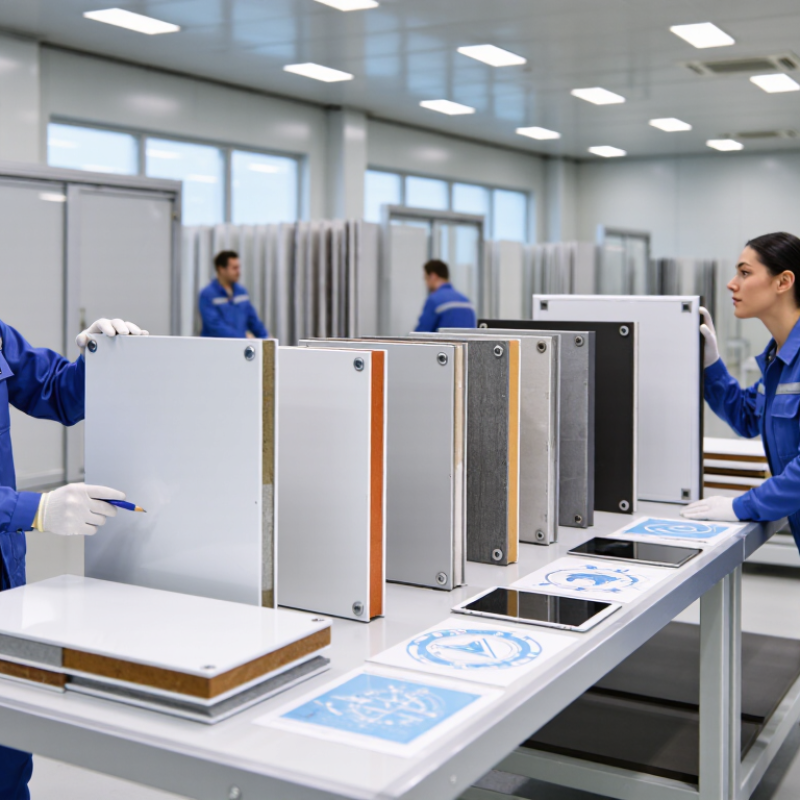
Hand-made cleanroom panels are factory-built wall or ceiling sections assembled through hands-on cutting, fitting, bonding, and finishing. A typical panel has two smooth metal skins around an insulated core, such as mineral wool or a rigid foam. The exact build varies with fire, thermal, and project requirements. The seams matter. Workers form or fit the edges, then seal joints to limit gaps where dust could collect. Door frames, windows, and service openings may also be integrated to match room drawings.
Handmade does not mean improvised. Reliable production uses controlled measurements, suitable adhesives, and checks for flatness, bond strength, and cleanable surfaces. Small differences can still occur between panels, so inspect samples and confirm dimensions before installation. A glossy face alone proves little. Core choice, edge details, and site assembly all affect performance. There is no universal best core. The right specification depends on the room’s process and required conditions. Panels also cannot provide cleanroom performance by themselves; ventilation, filtration, sealing, and maintenance matter. One useful question is how the maker documents these checks. It is easy to overlook.

Hand-made cleanroom panels start with approved drawings and carefully selected face sheets, core material, and perimeter framing. Technicians check material thickness and panel dimensions before cutting. Even a small error can complicate installation later. The cut edges are cleaned, and the frame is fitted around the core. Adhesive is applied in a controlled layer so the surfaces bond evenly without excess squeeze-out.
Details matter.
The assembled panel is pressed flat while the adhesive cures. Workers then trim the edges, form openings for doors or services when specified, and seal exposed joints to limit dust traps. Each panel is checked for dimensions, surface defects, and visible bonding gaps. Some projects also require documented checks against agreed flatness, fire, or cleanability criteria. Requirements vary, so one panel design should not be assumed to suit every room. A practical lesson from production is that neat faces alone prove little; hidden edges and consistent sealing deserve equal attention. Imperfections can still occur, and careful inspection helps catch them before panels reach the site.
Top Hand Made Cleanroom Panel Manufacturers in China
Key Standards for Cleanroom Panel Quality
Cleanroom panels do not create a cleanroom rating alone. Their joints, coatings, flatness, and resistance to cleaning chemicals affect how well the room performs over time. ISO 14644-1:2015 sets airborne particle limits: an ISO Class 5 room allows up to 3,520 particles per cubic metre at 0.5 micrometres or larger; Class 7 allows 352,000. These figures describe room air, not panel quality. Still, they show why tight seams and smooth, easy-to-clean surfaces matter. Ask for dimensional tolerances, core and facing specifications, and installation details—not just a cleanroom label.
Fire performance also needs documented evidence. ASTM E84 measures surface flame spread and smoke development; required limits depend on the project specification and local codes. Review the actual test report and confirm it applies to the panel’s complete assembly, including its core and finish. Check that samples resist the cleaning agents used on site. A small coating defect may look harmless at delivery, yet become difficult to clean after repeated use. Specifications can be imperfect; field inspection still matters.
Tips: Inspect panel edges, corners, and cut-outs under bright light. Request batch-specific test documents, then compare them with the approved submittal. If a joint looks uneven, pause installation and investigate. Don’t assume.
ISO 14644-1 airborne particle concentration limits illustrate the cleanliness levels cleanroom panels help maintain.
The chart shows maximum concentrations of airborne particles ≥0.5 μm per cubic metre for the listed ISO classes. These are room-air cleanliness limits, not panel certification values. Panel quality should also be assessed against project requirements for factors such as surface cleanability, sealing, dimensional accuracy, and fire performance.
Leading hand-made cleanroom panel manufacturers in China are distinguished by process control, not polished catalogs. Buyers should examine steel-skin thickness, core density, flatness, and joint details. A tight-looking seam can still leak if the sealant is uneven. Small flaws matter.
Grand View Research estimated the global cleanroom technology market at USD 5.13 billion in 2022 and projected 6.2% annual growth from 2023 to 2030. This figure covers more than panels, so it should not be treated as panel-market data. Still, it reflects rising demand for controlled production environments. Strong manufacturers can provide material traceability, dimensional inspection records, and test documentation suited to a project’s cleanliness and fire-performance requirements. Ask how they protect panel edges during shipping, too; dents can complicate installation.
For hand-made panels, production skill shows in consistent corners, clean cutouts, and stable dimensions across a batch. Request a sample with the actual finish and core, then inspect its joints under site lighting. A factory visit can reveal whether operators follow repeatable work instructions or rely mainly on individual experience. Neither approach guarantees perfection. Even experienced teams can miss details, so clear acceptance criteria and documented checks remain essential. ISO 14644 defines cleanroom air cleanliness, but panel selection must also consider the room’s intended use, cleaning routine, and installation quality.
Top Hand Made Cleanroom Panel Manufacturers in China
Comparing cleanroom panel manufacturers starts with measurable performance, not polished product photos. Request panel thickness, core density, surface coating, fire-test results, and documented joint details. ISO 14644-1:2015 classifies cleanrooms by airborne particle concentration. For particles ≥0.5 μm, its limits are 3,520 particles per cubic metre for ISO Class 5 and 352,000 for Class 7. These figures classify room air, not panels, so don’t treat them as proof of panel quality.
Compare samples and technical documents side by side. Check whether the panel’s edges stay square, whether seams align tightly, and whether the finish resists the cleaning agents used at your site. Ask how performance was tested and whether the report covers the exact panel construction you plan to buy. Small gaps matter. A glossy surface can look reassuring, yet conceal uneven joints. That detail is easy to overlook.
Tips: Request a sample, test a real corner joint, and verify fire and thermal data against the proposed specification. Record unanswered questions, too. One supplier may have better paperwork; another may offer more consistent fabrication. Neither advantage replaces installation checks.
A practical, brand-neutral comparison of common hand-made cleanroom panel constructions and the specifications buyers should verify with each manufacturer.
| Panel construction | Typical core and thermal conductivity | Common thickness range | Key advantages | Points to verify | Typical application fit |
|---|---|---|---|---|---|
| Rockwool core | Mineral wool; commonly about 0.036–0.045 W/(m·K), depending on product density and test method. | 50–150 mm | Non-combustible core options are available; useful where fire performance and acoustic insulation are priorities. | Request the tested fire classification for the complete panel assembly, not just the core. Check edge sealing, moisture protection, density, and joint details. | Projects prioritizing fire performance, including many industrial and technical areas. |
| PIR core | Polyisocyanurate foam; commonly about 0.020–0.026 W/(m·K), subject to formulation and test conditions. | 50–150 mm | Good insulation performance at relatively low thickness; typically lighter than mineral-wool panels of comparable size. | Confirm fire-test documentation, smoke-related requirements, joint construction, and whether the declared thermal value applies to the core or the complete panel. | Temperature-controlled clean areas where insulation and lower panel weight are important. |
| PU core | Polyurethane foam; commonly about 0.022–0.028 W/(m·K), depending on formulation and measurement method. | 50–150 mm | Efficient thermal insulation and a comparatively light panel construction. | Compare the documented fire performance of the complete assembly, foam formulation, dimensional stability, and compatibility with the project’s fire code. | Insulated cleanroom envelopes and temperature-controlled spaces, subject to project fire requirements. |
| EPS core | Expanded polystyrene; commonly about 0.034–0.040 W/(m·K), depending on density and grade. | 50–150 mm | Often a cost-conscious, lightweight option with straightforward fabrication. | Check fire classification and code acceptance carefully. Verify panel strength, skin bonding, joint sealing, and suitability for the intended cleanroom conditions. | Applications where budget and basic insulation are priorities and the fire strategy permits this construction. |
| Aluminum honeycomb core | Cellular aluminum core; thermal performance varies significantly with cell geometry, skins, and construction. | Typically 50–100 mm; confirm available sizes with the supplier. | Can provide a rigid, lightweight panel with a flat surface when correctly manufactured. | Request panel-specific load, deflection, impact, joint, and fire-test data. Check edge reinforcement and fixing details. | Areas needing a rigid, smooth partition system or where panel weight and surface flatness matter. |
| Paper honeycomb core | Cellular paper core; thermal performance is product-specific and is generally not the primary selection criterion. | Typically 50–100 mm; confirm available sizes with the supplier. | Lightweight construction that can be suitable for interior partitions in controlled environments. | Verify moisture resistance, fire classification, impact resistance, edge sealing, and whether the intended cleaning regime is suitable. | Interior partitions with controlled exposure and project requirements that accept the tested construction. |
Comparison note: Values are indicative ranges for common product constructions, not guaranteed specifications. Actual performance depends on materials, panel design, thickness, manufacturing tolerances, and test methods. Compare current technical data sheets and accredited test reports for the complete panel assembly before selection.