



Choosing the right palletizing systems can shape your warehouse performance for years. A suitable system protects products, reduces repetitive lifting, and keeps outbound schedules dependable. However, the fastest machine is not always the best investment. A carton line producing 20 cases per minute may still fail when package sizes change frequently.
This guide presents ten practical tips for evaluating palletizing equipment with greater confidence. The recommendations reflect common lessons from industrial packaging projects, including layout reviews, production trials, and maintenance planning. They consider product weight, case dimensions, pallet patterns, available floor space, safety requirements, and future growth. Small details matter. A poorly placed conveyor can create awkward access for operators and technicians. An unsuitable gripper may crush fragile boxes or release unstable loads.
Look beyond the sales demonstration. Ask how the equipment performs during shift changes, product variation, and routine cleaning. Request verified cycle data, service response details, training support, and references from comparable facilities. Experienced integrators should explain limitations clearly, not hide them behind impressive specifications. Even careful planning can miss something. That is why testing real cartons and reviewing failure points are essential.
A reliable decision balances output, flexibility, safety, integration, and total ownership cost. It also leaves room for honest reconsideration. Your operation may need a simpler solution than expected, or more automation than today’s budget allows. These ten tips will help you compare palletizing systems logically and select equipment that supports people, products, and long-term operational stability.
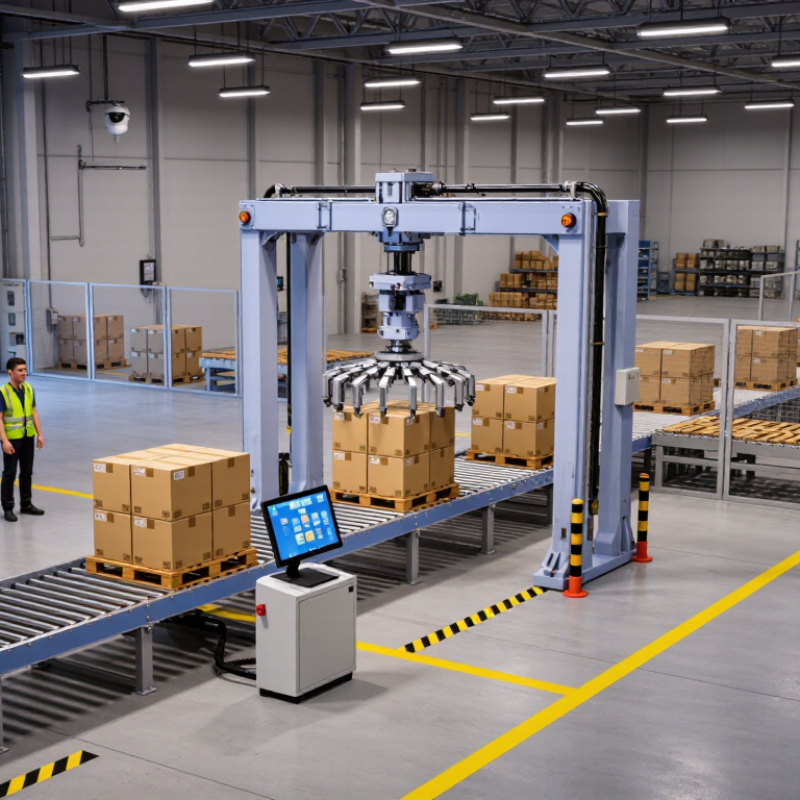
Choosing a palletizing system starts with two facts: what the product is and how quickly it must move.
Product details shape every mechanical decision. Record dimensions, weight, center of gravity, surface texture, and packaging strength. A sealed carton behaves differently from a soft bag. Glass containers demand controlled acceleration and careful impact management. Dusty packaging may need different gripping surfaces. Small details matter.
Throughput must be measured, not guessed.
Count cases per minute during normal production, then record peaks, changeovers, and short stoppages. Include the required pallet pattern, layer count, and pallet exchange time. A system rated for an ideal rate may struggle beside a real conveyor.
Leave practical margin, but do not buy capacity that sits idle. Historical production logs offer stronger evidence than a hopeful forecast.
We once treated an average rate as the target. Peak demand exposed the mistake. That assumption needed correction.
Ask operators to describe difficult products and awkward shifts.
Their experience often reveals crushed corners, unstable loads, or inconsistent case spacing. Test representative samples, including the weakest package. Confirm load stability after wrapping, transport, and storage.
Review the results with engineers and safety personnel. A careful specification should state acceptable damage, accuracy, uptime, and future volume. It should also identify what remains uncertain.
Perfect predictions are rare.
A strong palletizing system begins with the pallet pattern, not the robot. Measure case length, width, height, and weight across every product variation. A column stack may improve vertical compression, while an interlocked pattern can resist shifting. The choice depends on carton strength, stretch wrapping, and transport vibration. MHI’s 2024 Annual Industry Report found that 55% of respondents expected to increase technology investment within two years. That investment should solve a measured handling problem, not simply add automation.
Tip: Test the real load.
Build sample pallets using the heaviest and weakest packaging. Check overhang, corner alignment, center of gravity, and forklift entry. A small overhang can damage cartons or reduce stability. Also test mixed-SKU pallets, trays, bags, and irregular cases. PMMI’s packaging automation research identifies SKU proliferation and packaging variation as continuing automation challenges. Your system may handle one perfect case beautifully, then struggle with a crushed carton. That uncomfortable result matters. Record it.
Tip: Design for variation.
Set allowable limits for load height, weight, compression, and pattern changes. Use sensors to verify case orientation and pallet position before stacking. Packaging changes should trigger a controlled test, not an informal adjustment on the production floor. I would also review rejected pallets after several shifts. Operators often reveal problems that factory trials miss. The best pattern on paper may fail when film tension, humidity, or damaged cartons enter the process. Test more than once.
Choosing the right palletizing system starts with product type, speed, and available floor space. A robot palletizer suits mixed cases, frequent changeovers, and compact production areas. It can lift cartons consistently and adjust stacking patterns through programmed recipes. However, programming, guarding, and operator training require skilled support. A robot is not automatically the cheapest choice.
Conventional palletizers remain effective for stable, high-volume lines. They often handle one case size at a predictable speed. Their mechanical layout may be easier for maintenance teams to understand. Yet they need more dedicated space and may struggle when packaging changes. Check access around belts, transfers, and pallet magazines before approving a layout. Small clearance errors become daily delays.
Hybrid palletizing combines automated movement with selected manual tasks. It can suit seasonal demand, varied products, or moderate budgets. For example, a robot may stack mixed cartons while workers load pallets and inspect labels. This setup can reduce capital pressure, but handoff points must be clear. Measure cases per minute, peak shifts, pallet height, and changeover time. Then test real cartons, not ideal samples. We once saw a tidy simulation fail because soft boxes leaned after wrapping. The lesson is uncomfortable: estimates can hide handling problems. Ask for safety documents, service terms, and performance data from comparable applications. Reliability comes from evidence, not confident promises.
10 Tips for Choosing the Right Palletizing Systems
Tip 1: Measure the real workspace, not only the floor plan. Record ceiling height, column positions, aisle widths, and forklift routes. Leave room for operators to inspect equipment safely. A compact cell may look efficient, yet restricted access can slow every shift. Tip 2: Check pallet sizes, load weights, and stacking patterns before comparing equipment. Small product changes can affect reach, speed, and stability.
Tip 3: Review integration needs with your existing conveyors, scanners, packaging machines, and warehouse controls. Ask for clear data connections and practical testing procedures. I have seen projects delayed because one older machine used an unexpected signal format. Tip 4: Request a realistic cycle-time trial using your actual cartons. Laboratory demonstrations can be too perfect. Plan for variation.
Tip 5: Treat guarding, emergency stops, access doors, and operator visibility as design requirements. Confirm risk assessments and applicable workplace safety rules with qualified specialists. Tip 6: Examine maintenance access closely. Can technicians reach motors, sensors, and grippers without dismantling half the cell? Keep common spare parts available. Tip 7: Check cleaning needs, dust levels, temperature, and humidity. These details often influence sensor reliability. Tip 8: Train operators before full production begins. Clear procedures reduce rushed decisions. Tip 9: Discuss software updates, troubleshooting support, and documentation. Tip 10: Compare energy use and future expansion costs, not just the purchase price. A cheaper system may become expensive when small changes require major redesigns.
The chart ranks practical evaluation priorities on a 1–10 planning scale. Space, product flow, integration, safety, and maintainability should be assessed together before selecting a palletizing solution.
A suitable system should fit the available footprint, support the required throughput and payload, connect with upstream and downstream equipment, meet applicable machine-safety requirements, and allow easy access for inspection, cleaning, and preventive maintenance.
A palletizing system should be judged by total cost, not its purchase price. Include grippers, conveyors, guarding, integration, training, energy, maintenance, and planned downtime. A low-cost cell can become expensive when every format change needs engineering support. Build a five-year cost model using actual case weights, pallet patterns, shift hours, and changeover frequency. Small details matter. For example, a difficult-to-clean conveyor may add hours during weekly sanitation.
Scalability deserves equal attention. The International Federation of Robotics reported 541,302 industrial robots installed worldwide in 2023, with operational stock reaching about 4.28 million units. This growth reflects wider automation adoption, but capacity plans still require caution. Ask whether the system can add a second robot, new pallet sizes, or vision inspection without replacing the control platform. Deloitte’s 2023 smart manufacturing research found that 86% of manufacturing executives expect smart factory initiatives to support competitiveness within five years. That expectation is strong, perhaps too strong, if data integration is ignored.
Supplier support often decides performance after installation. Request response-time targets, spare-parts availability, remote diagnostics, software ownership terms, and technician coverage. Test support with a detailed fault scenario before signing. A polished demonstration proves little. The supplier should also provide acceptance criteria based on throughput, placement accuracy, recovery time, and changeover minutes. Even experienced teams sometimes underestimate operator training. That is worth challenging early.
| Tip | Evaluation Dimension | Key Data to Collect | Practical Screening Benchmark | Why It Matters | Evidence to Request |
|---|---|---|---|---|---|
| 1 | Define the required throughput | Cases or bags per minute, pallets per hour, operating shifts per day, and peak-season demand. | Design for normal demand plus 15–25% reserve capacity where future growth is expected. | A system sized only for current output may become a production constraint as volumes increase. | Validated cycle-time calculations, product samples, layer-pattern simulations, and a written capacity guarantee. |
| 2 | Calculate total cost of ownership | Purchase price, installation, controls, guarding, utilities, labor, maintenance, spare parts, downtime, and decommissioning. | Compare a 5–10 year TCO model rather than evaluating equipment price alone. | Lower acquisition cost can be offset by higher labor, maintenance, energy, or downtime costs. | A line-item quotation, annual operating-cost assumptions, maintenance schedule, and sensitivity analysis. |
| 3 | Measure labor impact | Operators per shift, manual palletizing hours, overtime, injury exposure, training time, and redeployment opportunities. | Document labor savings as productive hours per shift, not only as a headcount reduction. | Automation may reduce repetitive work while allowing employees to move to quality, replenishment, or material-handling tasks. | Before-and-after labor study, staffing plan, ergonomic assessment, and training requirements. |
| 4 | Verify product and pallet compatibility | Product dimensions, weight, packaging material, coefficient of friction, pallet size, load height, and allowable compression. | Test every major SKU and pallet pattern under production-speed conditions. | Products with different sizes, surfaces, or stability characteristics may require different grippers, tooling, or patterns. | Factory acceptance test results, sample-load photographs, maximum load-height data, and SKU changeover records. |
| 5 | Assess scalability and flexibility | Number of supported SKUs, recipe capacity, additional pallet lanes, spare input/output capacity, and modular expansion options. | Prefer recipe-based control and modular interfaces that can support planned product or volume changes. | Scalable equipment reduces the risk of replacing the complete cell when products, patterns, or output targets change. | Expansion layout, available I/O capacity, software architecture, change-part list, and future upgrade pricing. |
| 6 | Review reliability and availability | Mean time between failures, mean time to repair, planned maintenance hours, fault history, and expected operating availability. | Set an availability target of at least 95% for the complete palletizing cell, excluding planned breaks and scheduled maintenance. | Cell-level performance is more meaningful than the uptime of an individual robot or conveyor. | Reference-site performance data, downtime definitions, fault logs, maintenance intervals, and acceptance-test criteria. |
| 7 | Evaluate changeover performance | Time to change SKU, pallet pattern, tooling, stretch-wrap settings, labels, and operating recipes. | Target repeatable recipe changes in 10–20 minutes for frequently produced products, subject to line complexity. | Shorter changeovers increase available production time and make smaller production batches more economical. | Timed demonstrations, standard operating procedures, recipe-management screenshots, and changeover video evidence. |
| 8 | Confirm safety and compliance | Risk assessment, guarding, safety scanners, emergency stops, lockout/tagout provisions, access points, and local regulatory requirements. | Require documented risk reduction and validated safety functions before production acceptance. | Safety must cover the complete cell, including conveyors, pallet dispensers, wrapping equipment, and manual access areas. | Risk assessment, safety-circuit validation, electrical documentation, operator training materials, and compliance certificates. |
| 9 | Check integration and data visibility | PLC and network protocols, warehouse-management connectivity, production reporting, alarm history, remote diagnostics, and cybersecurity controls. | Require real-time counts, fault codes, recipe status, and downtime reasons from the cell. | Reliable data supports OEE analysis, faster troubleshooting, inventory accuracy, and continuous improvement. | Interface specification, sample dashboards, data tags, cybersecurity measures, and integration test results. |
| 10 | Compare supplier support and lifecycle service | Response time, local technicians, spare-parts availability, warranty length, training, preventive maintenance, and software support. | Define service-level targets, including remote response within 4 business hours and critical-parts availability appropriate to the operation. | Technical support can have a greater effect on long-term uptime than the initial equipment specification. | Service-level agreement, escalation process, spare-parts list, warranty terms, training plan, and customer references. |
| Decision rule: Select the system with the strongest lifecycle business case, not necessarily the lowest purchase price. Validate throughput, availability, safety, changeover time, and TCO assumptions through documented testing using representative products and operating conditions. | |||||
Note: The benchmarks are practical screening ranges for initial comparison. Final targets should be confirmed through a site-specific risk assessment, product trials, production schedule, and contractual acceptance criteria.