




What Are the Top Types of Industrial Mixing Technology?
Industrial mixing technology shapes how powders disperse, liquids blend, heat moves, and products maintain consistent quality. A tank’s bright steel walls may look simple, but its impeller, baffles, and flow pattern can determine whether a batch succeeds. Small shifts in viscosity, batch size, or shear can change the result. The details matter.
Grand View Research’s Industrial Agitators Market report valued the global market at USD 4.06 billion in 2023. It forecast 5.1% compound annual growth through 2030. That figure covers agitators, not every mixing method. The distinction matters. In Handbook of Industrial Mixing: Science and Practice, mixing specialists Edward L. Paul, Victor A. Atiemo-Obeng, and Suzanne M. Kresta describe mixing as “the process of reducing nonuniformities in a fluid by eliminating concentration and temperature gradients.” This definition is useful, though it cannot capture every plant-floor compromise.
This guide compares the leading types of industrial mixing technology, from impeller-driven tanks to inline rotor-stator systems, static mixers, and powder blenders. Each handles materials differently. A static mixer has no moving parts, while a rotor-stator can create intense shear in a compact zone. Neither is automatically better. One limitation is easy to miss: published performance figures rarely reproduce a plant’s exact viscosity, temperature, or operating schedule. The right choice depends on the material, process goal, cleaning needs, and scale. A mixer that performs beautifully in a lab may behave differently in a full production vessel. That deserves scrutiny.
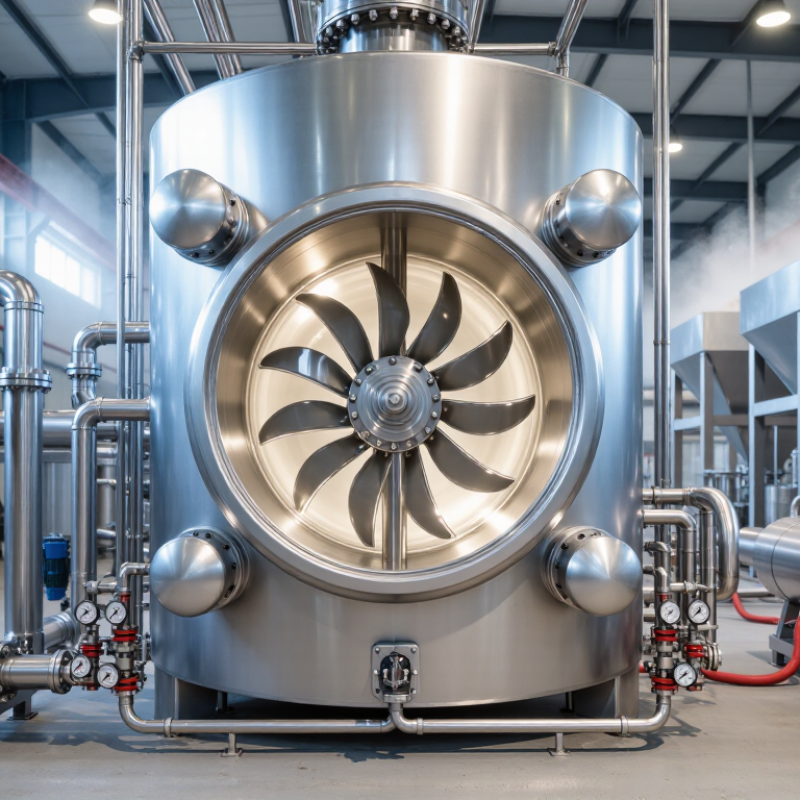
Core Principles of Industrial Mixing Technology
Core Principles of Industrial Mixing Technology
Industrial mixing is the controlled movement of materials to achieve a chosen result. That result may be a uniform blend, suspended particles, faster heat transfer, or a stable emulsion. The equipment must match the material and process. A thin liquid behaves differently from a thick paste. Small details matter.
Flow pattern, shear, and circulation are central design principles. An impeller creates movement, while tank shape and baffles influence how that movement travels. In low-viscosity liquids, turbulent flow often spreads material quickly. More viscous fluids may move in layers, making careful impeller selection essential. Too much shear can damage delicate ingredients; too little can leave visible streaks or settled solids.
Engineers also consider power input, mixing time, and heat generation. These factors interact, so changing speed alone may not solve a blending problem. During scale-up, matching tip speed or power per unit volume can produce different results. A calculation may miss how a vessel’s geometry changes circulation. Measurements from pilot runs, such as temperature variation and blend uniformity, help reveal those gaps. The best operating point is often a compromise, and it deserves another look when materials or production conditions change.
What Are the Top Types of Industrial Mixing Technology? - Core Principles of Industrial Mixing Technology
| Technology | Core Principle | Typical Applications | Main Strengths | Key Considerations |
|---|---|---|---|---|
| Agitated-tank mixing | A rotating impeller creates bulk circulation and turbulence within a vessel to blend liquids, suspend solids, or promote heat and mass transfer. | Liquid blending, dissolving, slurry preparation, and batch reactions. | Flexible operation across many vessel sizes and process duties; impeller design can be matched to the material. | Performance depends on vessel geometry, impeller type, speed, and fluid properties; baffles may be needed to limit swirling. |
| Rotor-stator mixing | A fast-moving rotor works close to a stationary stator, generating intense shear as material passes through narrow openings. | Emulsification, dispersion of powders, and reduction of agglomerates in liquids. | Provides strong local shear and can produce fine, more uniform dispersions. | Can introduce heat and consume more energy than lower-shear methods; may be unsuitable for shear-sensitive materials. |
| Static (motionless) mixing | Fixed elements inside a pipe repeatedly split, redirect, and recombine flowing streams; mixing is driven by the process flow rather than a motorized agitator. | Continuous blending, inline dosing, and mixing of compatible liquid streams. | No moving mixing parts and compact inline installation; can provide continuous operation. | Creates pressure drop; effectiveness depends on flow rate, viscosity, and element design. Cleaning can be challenging in some services. |
| High-shear dispersing | A high-speed mixing head produces intense velocity gradients and local turbulence to break down droplets or disperse particles. | Powder wet-out, pigment dispersion, and preparation of emulsions and suspensions. | Can rapidly improve dispersion and reduce visible lumps when used with suitable ingredients and process conditions. | High shear does not guarantee a stable emulsion; formulation, temperature, and downstream stabilization also matter. |
| Ribbon and paddle mixing | Helical ribbons or paddles move bulk solids through a horizontal trough, creating turnover and circulation within the powder bed. | Dry powders, granules, and some moist or cohesive bulk solids. | Well suited to batch blending of large quantities of free-flowing solids. | Mixing quality can be affected by fill level, particle size, density differences, and cohesive behavior; overmixing may cause segregation. |
| Kneader mixing | Intermeshing or closely spaced blades apply compression, folding, and shear to work highly viscous or plastic materials. | Doughs, pastes, putties, sealants, and other high-viscosity compounds. | Can process materials that conventional impellers struggle to circulate. | Often requires high torque and careful temperature management; discharge and cleaning may take more effort. |
| Planetary mixing | One or more tools rotate on their own axes while orbiting the vessel, sweeping a broad volume of material. | Viscous pastes, adhesives, filled compounds, and small-batch formulations. | Provides broad vessel coverage and effective mixing of viscous materials without relying on simple bulk circulation. | Tool and vessel clearances must suit the material; capacity and cycle time depend on formulation and equipment geometry. |
The appropriate technology depends on material viscosity, phase composition, batch or continuous operation, required product quality, and process constraints.
Related Posts
-
Top 10 Industrial Mixing Technologies for Your Business Needs?
-

Top 10 Benefits of Smart Processing Systems for Global Buyers?
-

Top 10 Food Automation Systems Transforming China's Culinary Industry?
-
7 Best Case Packing Systems for Global Buyers
-

Top Food Manufacturing Equipment Suppliers Worldwide?
-
How to Choose the Best Industrial Processing Equipment?